The apprenticeship contract
What is an apprenticeship contract?
The apprenticeship contract is an employment contract that combines practical training in a company with theoretical teaching at the school. It gives the apprentice the same rights as the company’s other employees. The aim is to obtain a diploma or qualification listed in the RNCP (the French national register of professional certifications) and therefore recognised by the State.
How long does an apprenticeship contract last?
This is a fixed-term contract lasting from 6 to 24 months (an extension is possible in certain specific cases). The length of the training is set by an agreement between the CFA (EIDM school), the employer and the apprentice and may be equal to or shorter than the study cycle, depending on the apprentice’s initial level of skill. The work-study pattern varies according to the programme chosen — for example: 3 days at school and 2 days in the company.
Who is eligible?
Young people from 16 to 29 years old inclusive (up to the day before their 30th birthday).
There is no upper age limit for apprentices recognised as disabled workers, elite athletes, or apprentices planning to start or take over a business.
What is the pay?
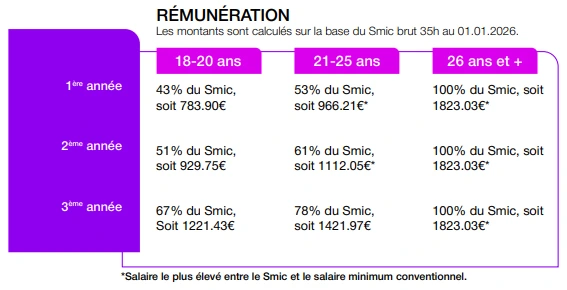
The apprentice receives a minimum wage corresponding to a percentage of the French minimum wage (SMIC), depending on their age and the number of years of apprenticeship, i.e. between 27% and 100% of the SMIC. These amounts may be higher if a collective agreement applies within the company (SMC). As an employee, the apprentice is entitled to 5 weeks of paid holiday a year, plus 5 extra days of leave to prepare for final examinations (to be taken in the month before the exams).
Who funds the training?
Training costs are covered in part or in full by the OPCO (skills funding body) that the company belongs to. The amount covered depends on the length of the contract and the professional sector of the host organisation.
From 8 March 2026
Companies will be able to receive a recruitment subsidy under the conditions set out below:
- Companies with fewer than 250 employees: €2,000 for qualifications at Bac +3 to Bac +5 level (RNCP Levels 6 and 7)
- Companies with more than 250 employees: €750 for qualifications at Bac +3 to Bac +5 level (RNCP Levels 6 and 7)
- For all types of company: up to €6,000 for recruiting an apprentice with RQTH status (official recognition as a disabled worker)
This subsidy applies only to the first year of the contract and is paid monthly by the ASP (the French services and payment agency).
A decree setting out how the scheme is to be applied was published on 6 March 2026.
The professional training contract
What is a professional training contract?
The professional training contract is an employment contract that combines practical training in a company with theoretical teaching at the school. It gives the trainee the same rights as the company’s other employees. A professional training contract cannot be signed with the State, with local authorities or with public administrative bodies.
How long does a professional training contract last?
This is a fixed-term contract lasting from 6 to 36 months (an extension is possible in certain specific cases). The length of the training is set by an agreement between the CFA (EIDM school), the employer and the apprentice, and may be equal to or shorter than the study cycle, depending on the apprentice’s initial level of skill. The work-study pattern varies according to the programme chosen — for example: 3 days at school and 2 days in the company.
Who is eligible?
Young people from 16 to 25 years old inclusive (up to the day before their 26th birthday).
Jobseekers aged 26 and over.
Recipients of income support benefits (RSA, ASS, AAH)
What is the pay?
Training costs are covered in part or in full by the OPCO (skills funding body) that the company belongs to. The amount covered depends on the length of the contract and the professional sector of the host organisation.
Who funds the training?
Training costs are covered in part or in full by the OPCO (skills funding body) that the company belongs to. The amount covered depends on the length of the contract and the professional sector of the host organisation.
The part-time internship
What is a part-time internship?
This is an internship agreement signed by the company, the student and the school. The internship can be split up and alternated with periods of classes. It is not subject to the company’s collective agreement. The intern keeps student status and receives a stipend for any internship lasting more than 2 months in practice.
How long does a part-time internship last?
The maximum length is 6 months full-time per academic year with the same employer.
Who is eligible?
Any student enrolled on a programme that gives them student status.
What is the stipend?
A stipend is compulsory when the internship lasts more than two months. The stipend, at a minimum hourly rate of €4.50, is a net amount: there are no social security contributions and it is not taxable.
Who funds the training?
Annual tuition fees are payable by the student. However, the company may choose to cover part or all of the fees.
The part-time fixed-term contract (CDD)
What is a part-time fixed-term contract?
A fixed-term contract (CDD) may be requested by the employee or by the employer, and its length is agreed in advance when the contract is signed. Part-time working means a contract in which the total hours worked by the employee are fewer than the statutory hours of a full-time contract. The student signs an employment contract that gives them the same rights as any other company employee.
How long does a part-time fixed-term contract last?
This is a fixed-term contract whose length is agreed between the employer and the employee, covering between 24 and 34 hours a week. Possible weekly patterns: half-days every day, or full days with days off not worked.
Who is eligible?
Employees aged 16 and over.
What is the pay?
The employee is paid on the basis of an hourly rate.
Who funds the training?
Annual tuition fees are payable by the employee. However, depending on the arrangements agreed with the company, the company may cover part or all of the fees if it wishes.
The part-time permanent contract (CDI)
What is a part-time permanent contract?
A permanent contract (CDI) may be requested by the employee or by the employer and runs for an indefinite period from the date the contract is signed. Part-time working means a contract in which the total hours worked by the employee are fewer than the statutory hours of a full-time contract. The student signs an employment contract that gives them the same rights as any other company employee.
How long does a part-time permanent contract last?
This is an open-ended contract whose hours are agreed between the employer and the employee, covering between 24 and 34 hours a week. Possible weekly patterns: half-days every day, or full days with days off not worked.
Who is eligible?
Employees aged 16 and over.
What is the pay?
The employee is paid on the basis of an hourly rate.
Who funds the training?
Annual tuition fees are payable by the employee. However, depending on the arrangements agreed with the company, the company may cover part or all of the fees if it wishes.